Home Blog Page 7

Rep. Julia Letlow May Challenge Louisiana Sen. Bill Cassidy in 2026 Republican Primary

Louisiana Congresswoman Julia Letlow (R) is reportedly considering a challenge to Senator Bill Cassidy in the Louisiana Republican Senate primary for 2026, according to a report by The Advocate. Letlow, who represents Louisiana’s 5th Congressional District, has not publicly confirmed her intentions, but she is reportedly weighing the possibility amid growing speculation within GOP circles.

Cassidy, a two-term senator, has faced criticism from some conservatives due to his 2021 vote to convict former President Donald Trump during the impeachment trial. This has opened the door for potential challengers from the party’s right flank. State Treasurer John Fleming has already declared his candidacy, while other Republicans, including State Senator Blake Miguez and Public Service Commissioner Eric Skrmetta, have expressed interest in entering the race.

Letlow, first elected to Congress in 2021, is considered a rising star within the Louisiana GOP. She secured reelection in 2024 and has built a reputation as a conservative legislator with strong support in her district.

Recent polling indicates that Cassidy may be vulnerable in the primary. A February 2025 survey by JMC Analytics showed Cassidy trailing Fleming 40% to 27% among likely Republican voters, with 33% undecided.

As the 2026 election approaches, Letlow’s potential entry into the race could significantly reshape the dynamics of the Republican primary and serve as a major test of Cassidy’s support within the party.

Blackburn, Salazar Introduce ‘NO FAKES Act’ to Protect Individuals and Creators from Digital Replicas

WASHINGTON, D.C. – Today, U.S. Senators Marsha Blackburn (R-Tenn.), Chris Coons (D-Del.), Thom Tillis (R-N.C.), and Amy Klobuchar (D-Minn.), along with U.S. Representatives Maria Salazar (R-Fla.) and Madeleine Dean (D-Penn.), introduced the bipartisan Nurture Originals, Foster Art, and Keep Entertainment Safe (NO FAKES) Act to protect the voice and visual likenesses of individuals and creators from the proliferation of digital replicas created without their consent:

“While AI has opened the door to countless innovations, it has also exposed creators and other vulnerable individuals to online harms,” said Senator Blackburn. “Tennessee’s creative community is recognized around the globe, and the NO FAKES Act would help protect these individuals from the misuse and abuse of generative AI by holding those responsible for deepfake content to account.”

“Nobody—whether they’re Tom Hanks or an 8th grader just trying to be a kid—should worry about someone stealing their voice and likeness,” said Senator Coons. “Incredible technology like AI can help us push the limits of human creativity, but only if we protect Americans from those who would use it to harm our communities. I am grateful for the bipartisan partnership of Senators Blackburn, Klobuchar, and Tillis, the support of colleagues in the House, and the endorsements of leaders in the entertainment industry, the labor community, and firms at the cutting edge of AI technology.”

“While AI presents extraordinary opportunities for technological advancement, it also poses some new problems, including the unauthorized replication of the voice and visual likeness of individuals, such as artists,” said Senator Tillis. “We must protect against such misuse, and I’m proud to co-introduce this bipartisan legislation to create safeguards from AI, which will result in greater protections for individuals and that which defines them.”

“Americans from all walks of life are increasingly seeing AI being used to create deepfakes in ads, images, music, and videos without their consent,” said Senator Klobuchar. “We need our laws to be as sophisticated as this quickly advancing technology. The bipartisan NO FAKES Act will establish rules of the road to protect people from having their voice and likeness replicated through AI without their permission.”

“In this new era of AI, we need real laws to protect real people,” said Representative Salazar. “The NO FAKES Act is simple and sacred: you own your identity—not Big Tech, not scammers, not algorithms. Deepfakes are digital lies that ruin real lives, and it’s time to fight back.”

“As AI’s prevalence grows, federal law must catch up—we must support technological innovation while preserving the privacy, safety, and dignity of all Americans,” said Representative Dean. “By granting everyone a clear, federal right to control digital replicas of their own voice and likeness, the NO FAKES Act will empower victims of deep fakes; safeguard human creativity and artistic expression; and defend against sexually explicit deepfakes. I’m grateful to work with a bipartisan group of colleagues on common sense, common ground regulations of this new frontier of AI.”

BACKGROUND

  • With the rapid advance of generative artificial intelligence (AI), artists and creators have already begun to see their voices and likenesses used without their consent in videos and songs created as nearly indistinguishable replicas.
  • In one high-profile example, AI-generated replicas of the voices of pop stars Drake and The Weeknd were used to produce a viral song titled “Heart on My Sleeve,” generating hundreds of thousands of listens on YouTube, Spotify, and other streaming platforms before it was flagged as a fake and removed from the platforms. 
  • The harmful effects of unauthorized AI-generated content go far beyond celebrities. For example, in Maryland, a Baltimore high school athletic director was arrested and charged after using AI to create a deepfake voice recording of the school’s principal that included racist and derogatory comments about students and staff – statements the principal never actually made.

NO FAKES ACT

The NO FAKES Act would address the use of non-consensual digital replications in audiovisual works or sound recordings by:

  • Holding individuals or companies liable if they distribute an unauthorized digital replica of an individual’s voice or visual likeness;
  • Holding platforms liable for hosting an unauthorized digital replica if the platform has knowledge of the fact that the replica was not authorized by the individual depicted;
  • Excluding certain digital replicas from coverage based on recognized First Amendment protections; and
  • Preempting future state laws regulating digital replicas.

Click here to read the bill text.

Ossoff and Cassidy Introduce Bipartisan Bill Aimed at Curbing Data Broker Practices

Washington D.C. — U.S. Senator Jon Ossoff is working across the aisle to put Americans back in control of their own data.

Sens. Ossoff, Bill Cassidy, M.D. (R-LA), and Ben Ray Luján (D-NM) recently introduced the bipartisan Data Elimination and Limiting Extensive Tracking and Exchange (DELETE) Act, legislation that would enable and empower Americans to request that data brokers delete their personal data.

The DELETE Act would direct the Federal Trade Commission (FTC) to create an online tool where Americans can submit a one-time data deletion request to all registered data brokers that hold their personal data. The bill would also create a ‘do not track list’ to prohibit companies from collecting these users’ data in the future.

“Data brokers are buying, collecting, and reselling vast amounts of personal information about all of us without our consent. This bipartisan bill is about returning control of our personal data to us, the American people,” Sen. Ossoff said. 

Data brokers are companies that collect, use, and sell personal data without a person’s knowledge.

Opinion: Senators, Reps Should Be Required to Annually Update Profile Portraits on Their Official Websites

The average age of members of the United States Congress has steadily increased over the years, creating a growing age gap between elected officials and the general public they serve. As of recent congressional sessions, the average age of a U.S. Senator is around 65 years old, while members of the House of Representatives average about 58. In contrast, the median age of the general U.S. population is approximately 39. This disparity has sparked discussions about representation, generational perspectives, and the long-term impact on policymaking.

Considering the recent example of former President Joe Biden, voters deserve an accurate and current glimpse of their government representatives, especially in Congress. Compared to presidents, members of Congress aren’t shown on television to the vast majority of their constituents.

Recently, as I undertook a voter directory project, I discovered that multiple senators and congressmen who still featured decade-old self-portraits on their official government website biography pages. While age should not be the sole criterion for evaluating a politician’s effectiveness, the imbalance in age representation contributes to ongoing debates about term limits, retirement expectations, and the need for fresh perspectives in government. Ultimately, a Congress that reflects the age diversity of the U.S. population could lead to more dynamic and responsive governance.

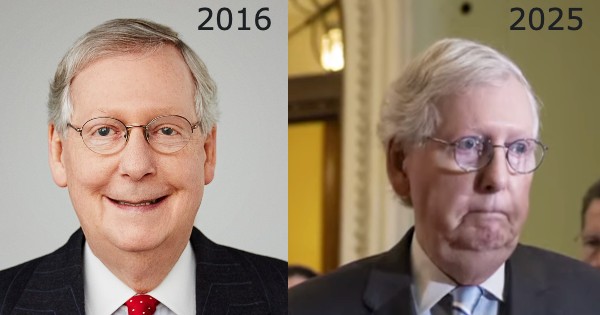
Some of the most glaring examples included one of the most high-profile members of the Senate, Mitch McConnell, who served as Senate Majority Leader, until his aging became eerily apparent due to several instances of McConnell freezing his facial expressions during public appearances. McConnell’s portrait, currently posted on his Senate site, as well as his YouTube channel and social media accounts, are from 2016, nearly a decade ago. Compare that picture to a recent image of McConnell:

As you can see, his current official online pages feature the near-decade-old portrait:

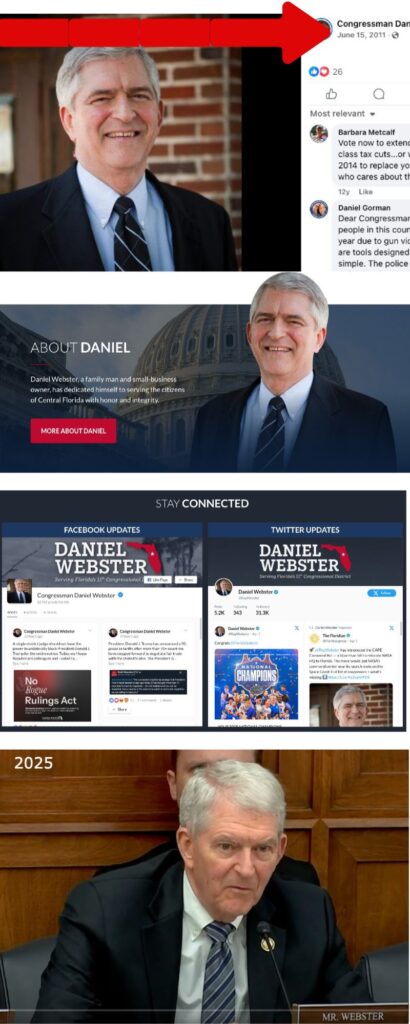
Other examples include Florida Congressman Daniel Webster, who still features a portrait that was taken 14 years ago:

Supporters of older congressional members often emphasize their deep experience, established relationships, and procedural expertise. However, the growing age gap raises questions about whether Congress accurately reflects the demographics of the nation. Young people, who constitute a significant portion of the voting population, often feel underrepresented in national leadership.

Many of the most powerful positions in Congress—such as committee chairs, leadership roles, and influential subcommittees—are held by older lawmakers, some of whom have served for decades. While experience and institutional knowledge can be valuable assets, critics argue that an aging Congress may struggle to fully understand or prioritize the concerns of younger Americans, including issues such the digital economy. In some cases, this generational disconnect can lead to outdated policy approaches or slower responses to rapidly evolving social and technological challenges.

If we can’t expect our elected officials to be transparent about their own appearance, how can we expect them to be transparent about anything?

North Carolina Abortion Ban Bill Won’t Advance, State House Speaker Says

A Republican-backed bill introduced this week that would ban abortion at any stage of pregnancy in North Carolina will not move forward, according to North Carolina House Speaker Destin Hall.

“I don’t think there’s any real desire in our caucus to hear that particular bill, so it’s not going to be heard in committee,” Hall told reporters after Tuesday’s House voting session.

The bill, introduced on Monday by Rep. Keith Kidwell and co-sponsored by two other House Republicans, aims to outlaw abortion from the moment of conception. It includes no exceptions except to save the mother’s life. Violating this law would carry felony charges and a civil penalty of $100,000.

Democrats immediately criticized the proposal and vowed to fight against it vigorously. Named the “Human Life Protection Act of 2025,” the bill mirrors legislation Kidwell proposed in 2023 that also failed to gain traction. At that time, Republicans were working behind the scenes to find a consensus on abortion restrictions that could unite the party.

That effort ultimately led to a 2023 law banning most abortions after 12 weeks, with exceptions allowing for abortions up to 20 weeks in cases of rape and incest, up to 24 weeks for fetal abnormalities, and at any point if a doctor determines it is a medical emergency. This law passed over a veto from then-Governor Roy Cooper, a Democrat. Newly-elected Governor Josh Stein, also a Democrat, would also likely veto this verison.

Hall stated on Tuesday that he doesn’t expect any significant changes to that law during this session. “We just passed, less than two years ago, really landmark pro-life legislation,” Hall said. “I think we need to give it time to see how it works. I don’t anticipate doing much more on that issue right now.”

Senate leader Phil Berger echoed Hall’s position, mentioning that he hadn’t reviewed Kidwell’s bill and did not foresee changes to the current 12-week law. “I don’t know that there’s support to pass a more restrictive bill and override a veto,” Berger remarked. “So I don’t see us moving in that direction.” He had previously stated last June that he did not support introducing additional abortion restrictions this year, clarifying that he was speaking only for himself.

Republican North Carolina Senator Expresses Skepticism on Trump Tariffs’ Odds to Succeed

During a Senate Finance Committee hearing yesterday, North Carolina Senator Thom Tillis (R) expressed skepticism about President Trump’s comprehensive tariff strategy. Addressing U.S. Trade Representative Jamieson Greer, Tillis asked, “Whose throat do I get to choke if this proves to be wrong?”

Tillis questioned the administration’s “alla prima,” or all-at-once, approach to imposing tariffs on multiple countries at the same time. He raised concerns about the potential negative impacts on American citizens, particularly those in lower-income brackets who might experience increased costs and job losses. Reflecting on his upbringing, Tillis asked, “Do you believe that over the next 14 months… the people in the trailer park where I grew up… how are they going to be feeling on Groundhog Day 2026?”

Greer acknowledged that he is “at the tip of the spear” in implementing trade policies but emphasized that President Trump is the ultimate decision-maker. He noted that the administration does not plan to offer exclusions, even for essential materials like steel and aluminum.

The hearing highlighted bipartisan concerns about the potential economic repercussions of the tariff strategy, with lawmakers seeking clearer accountability and objectives from the administration.

North Carolina Governor Stein Creates Council to Focus on School Safety

RALEIGH, NC – Today at Moore Square Magnet Middle School, North Carolina Governor Josh Stein announced the formation of his Advisory Council on Student Safety and Well-Being. The council will be co-chaired by Senate Democratic Leader Sydney Batch, Deputy Secretary William “Billy” Lassiter of the Department of Public Safety, and Heather Smith, the 2024 North Carolina Teacher of the Year.

“North Carolina’s children are our future, and it is crucial that they grow and learn in a safe environment that sets them on the right trajectory to thrive,” Stein said. “I am proud to establish this council of educators, mental health professionals, and law enforcement to identify ways to better keep our classrooms safe and our children healthy.”

Governor Stein’s advisory council will collaborate with state agencies and local leaders to propose policies that enhance student safety and wellbeing. The council will prioritize working with the General Assembly to implement cell phone-free classrooms and share best practices with communities.

“Student and school staff security and wellbeing is an essential part of public safety,” said Deputy Secretary of Public Safety William L. Lassiter, who oversees the Division of Juvenile Justice and Delinquency Prevention. “We must use the tools at our disposal to upgrade the physical infrastructure of our schools and train our school staff how to recognize and respond to the early warning signs that can lead to public safety threats. We know our students must feel safe and have a healthy mental well-being to achieve academically. Working together, we can keep our students and our schools safe.” 

Click here to read Governor Stein’s executive order establishing the Council on Student Safety & Well-Being.

The members of the Advisory Council are as follows:

  • Senate Democratic Leader Sydney Batch (co-chair)
  • William L. Lassiter, Deputy Secretary for the Division of Juvenile Justice and Delinquency Prevention, Department of Public Safety (co-chair)
  • Heather Smith, 2024 Burroughs Wellcome Fund North Carolina Teacher of the Year (co-chair)
  • Senator David W. Craven, Jr.
  • Representative Brian Biggs
  • Representative Lindsey Prather
  • Alan Duncan, Vice-Chair of the State Board of Education
  • Bettina Umstead, Board of Education Member, Durham Public Schools
  • Sharon Bell, Deputy Director, Division of Child and Family Wellbeing, North Carolina Department of Health and Human Services
  • Natalia Botella, Director, Public Protection Section, North Carolina Department of Justice
  • Dr. Ellen Essick, Section Chief for NC Healthy Schools, Department of Public Instruction
  • Karen Fairley, Executive Director of Center for Safer Schools, A Division of the State Bureau of Investigation
  • Anne Goldberg, School Counselor, Alamance-Burlington School System
  • Tara Hardy, School Social Worker, Craven County Schools
  • Roger “Chip” Hawley, Director of The North Carolina State Bureau of Investigation
  • Emma Hodson, In-House Counsel, Pitt County Schools
  • Kristie Howell, Chief Court Counselor-District 8, Division of Juvenile Justice and Delinquency Prevention, North Carolina Department of Public Safety
  • Melissa Lassen, BSN, RN, NCSN, Lead School Nurse, Chatham County Schools
  • Mark McHugh, Director of Safety, Charlotte-Mecklenburg Schools
  • Dr. Shaneeka Moore-Brown, President, North Carolina Parent Teacher Association
  • Asia Prince, Director of Court Programs, North Carolina Administrative Offices of the Courts
  • Deputy Rhyne Rankins, School Resource Officer, Iredell County Sheriff’s Office
  • Dr. Paul Smokowski, Executive Director, North Carolina Youth Violence Prevention Center
  • Beckie Spears, Principal, Wilkesboro Elementary School & 2024 Wells Fargo North Carolina Principal of the Year
  • Mary Katherine Stiles, M.A./S.S.P., School Psychologist, Cumberland County Schools
  • Justice Warren, Assistant Legal Counsel, North Carolina School Boards Association
  • Julie Cecelia Werry, Scholar Advisor, Morehead-Cain Foundation
  • Dr. Freddie Williamson, Superintendent of Public Schools of Robeson County

Sen. Ossoff Working Across the Aisle to Strengthen Oversight of Federal Prisons

 U.S. Senator Jon Ossoff is working across the aisle to strengthen Federal oversight and accountability of the Federal prison system.

Today, Sen. Ossoff launched a push to pass the bipartisan Federal Prisons Accountability Act of 2025, legislation he co-sponsored to make the Federal Bureau of Prisons (BOP) Director a U.S. Senate-confirmed position with a single 10-year term, following a nomination from the President of the United States. The bipartisan bill was recently introduced by Senators Mitch McConnell (R-KY), Chuck Grassley (R-IA), Rand Paul (R-KY), James Lankford (R-OK), Marsha Blackburn (R-TN), and Dr. Bill Cassidy (R-LA).

Sens. Ossoff and McConnell previously introduced the bill last Congress.

Currently, the BOP Director is appointed by U.S. Attorney General (AG) and not subject to Senate confirmation, despite having significant authority over taxpayer dollars and over 30,000 Federal employees. 

“In 2022, my bipartisan investigations as chair of the Permanent Subcommittee on Investigations revealed the depth of chaos and dysfunction that has undermined security and civil rights in the Bureau of Prisons for over a decade. This bill asserts the Senate’s authority to confirm nominees for BOP’s leadership and hold them to the highest standards,” Sen. Ossoff said.

Sen. Ossoff continues to work to reform the Federal prison system.

Last month, Sen. Ossoff warned AG Pam Bondi and BOP Associate Deputy Director Kathleen Toomey that their efforts to reduce pay for prison staff threaten the safety and security of prisons amid pre-existing staffing shortages.

In February, Sens. Ossoff and Chuck Grassley (R-IA) introduced the bipartisan Lieutenant Osvaldo Albarati Stopping Prison Contraband Act, which would crack down on the smuggling of contraband cellphones into Federal prisons by upgrading the charge of smuggling of a contraband cellphone into a Federal prison from a misdemeanor offense to a felony.

Last year, President Biden signed into law Sen. Ossoff’s bipartisan Federal Prison Oversight Act, historic prison reform legislation to overhaul independent oversight of the Federal Bureau of Prison’s 122 facilities nationwide by mandating routine inspections of all facilities by the DOJ Inspector General and establishing a new Ombudsman to investigate the health, safety, welfare, and rights of incarcerated people and staff.

Sen. Ossoff also passed into law his bipartisan Prison Camera Reform ActThis is an external link to reduce violence and civil rights abuses in America’s prisons.

Click here to read the bipartisan Federal Prisons Accountability Act of 2025.