As an incumbent Democrat in a southeastern state, Georgia Senator Jon Ossoff‘s seat ranks among the most vulnerable for the 2026 election. Still, his odds for re-election may have increased after a recent blunder by a potential opponent, Republican Congressman Mike Collins.
Collins’ campaign launch for the U.S. Senate in Georgia began with an unfortunate error: a campaign video posted on July 27 via his “Mike Collins War Room” account on X misspelled the state name as “Georiga” instead of “Georgia.” The video ended with the phrase, “Georiga, let’s ride!”
This mistake, which appeared to be unintentional, quickly went viral and became a hot topic online—especially since the typo remained visible on the campaign account for over 24 hours. Critics and social media users took the opportunity to mock the slip-up, with comments like “Is Georiga the 51st state?” The Collins team later explained that the video was created and uploaded by supporters rather than his official campaign account, which released its own version of the launch video (with the correct spelling) the following day.
Collins’ early digital misstep could potentially undermine his messaging regarding competence and voter trust.
“Mike Collins will certainly recover and move on from it,” AJC political columnist Ben Burnett told NewSouthPolitics.com. “But you can be sure, he’s going to take a little trolling. He’s a witty social media guy, himself. Collins gives plenty of clever one-liners. With a mistake like that, he knows he is going to hear about it.”
A silver lining could be found in the fact that Collins raised $22,000 in the 24 hours following his announcement, but beyond the embarrassment of a significant typo, the error raised broader concerns about the professionalism and attention to detail of a campaign that relies heavily on strong messaging.
Thanks to Gov. Brian Kemp’s support, Derrick Dooley is the early logical favorite to win the GOP primary. However, primary races, especially in midterm elections, can be brutal for political newcomers. Dooley, whose career background is in coaching college football, could fumble away his seemingly clear path to the party’s nomination.
WASHINGTON — U.S. Sen. Josh Hawley (R-Mo.) has introduced new legislation that would use federal tariff revenue to send direct rebate checks to working Americans, aligning with former President Donald Trump’s recent call to return tariff dollars to taxpayers.
The proposed bill, titled the American Worker Rebate Act, would provide checks of at least $600 per adult and child, amounting to $2,400 for a family of four. Modeled after the COVID-era stimulus payments, the rebates would be funded by what Hawley and supporters describe as “record-breaking” tariff revenue collected by the federal government.
“Americans deserve a tax rebate after four years of Biden policies that have devastated families’ savings and livelihoods,” Hawley said in a statement. “Like President Trump proposed, my legislation would allow hard-working Americans to benefit from the wealth that Trump’s tariffs are returning to this country.”
The U.S. collected nearly $30 billion in tariff revenue in June, and some forecasts project that total revenue could surpass $150 billion in 2025. If tariff revenue exceeds those projections, the bill would allow for an increase in the rebate amount.
Hawley announced the legislation shortly after Trump reiterated his support for a rebate-style policy tied to tariffs, further signaling alignment between the senator and the former president ahead of the 2024 election.
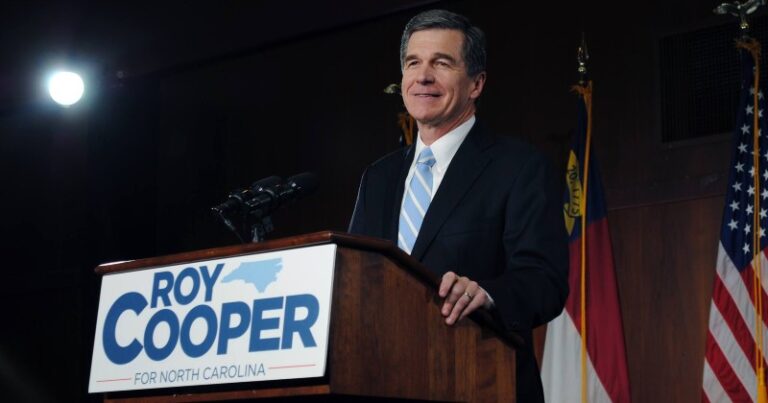
RALEIGH, N.C. — Former North Carolina Gov. Roy Cooper raised $3.4 million in the first 24 hours of his U.S. Senate campaign, setting a new record for a Democratic Senate candidate and underscoring the competitiveness of the state’s 2026 race.
The total includes $2.6 million in direct contributions to Cooper’s campaign, with 95 percent of donations at $100 or less, according to his team. An additional $900,000 was raised through joint fundraising efforts with the Democratic Party, which enables larger individual contributions.
Cooper formally launched his campaign Monday, emerging as Democrats’ top contender for the seat being vacated by retiring Republican Sen. Thom Tillis. The race is expected to be one of the most closely watched and expensive in the country.
Cooper is likely to face Republican National Committee Chair Michael Whatley, who is expected to launch his campaign soon with the backing of former President Donald Trump. Trump’s daughter-in-law, Lara Trump, had also been considered a possible candidate but opted not to run.
Former Rep. Wiley Nickel, who had previously entered the race, withdrew Tuesday and endorsed Cooper, effectively clearing the Democratic field.
“I proudly endorse Governor Cooper for U.S. Senate and look forward to doing everything I can to help him flip this Senate seat from red to blue,” Nickel said in a statement. He added that he still plans to remain involved in public service, with future plans to be announced soon. Nickel is now reportedly considering a bid for district attorney in Wake County, the state’s largest.
Cooper, who previously served as chair of the Democratic Governors Association, was heavily recruited by national Democrats. He has twice won statewide elections in North Carolina while Trump was on the ballot, a sign of his crossover appeal in a swing state.
Rep. Don Davis, another potential Democratic contender, is now expected to forgo a Senate bid in light of Cooper’s entry into the race.
Cooper’s early fundraising haul surpasses the previous record for a Senate Democratic candidate, set by Amy McGrath of Kentucky, who raised $2.5 million in the first 24 hours of her 2020 campaign against Senate Minority Leader Mitch McConnell.
With both Cooper and Whatley bringing strong national fundraising networks, the North Carolina race is poised to be a key battleground in the fight for Senate control in 2026.
According to reports from Politico and PoliticalWire.com, former North Carolina Governor Roy Cooper will run in the Democratic Primary in the 2026 US Senate Primary for the seat to be vacated by soon-to-be-retired Senator Thom Tillis.
“Roy Cooper is expected to announce his campaign for the North Carolina Senate as soon as Monday, according to two people directly familiar with the former governor’s decision” Politico reported.The popular, former two-term governor’s entrance into the Senate race — for a seat Republican Sen. Thom Tillis is leaving open with his announcement last month that he won’t seek reelection — is likely to transform the Senate race into the most competitive of 2026. Democrats, facing a difficult path to seizing control of the Senate next year, landed their dream recruit with Cooper, who would enter the race as a favorite.”
Cooper was succeeded by former state attorney general, Josh Stein, a fellow Democrat who coasted to a double-digit victory last November despite Donald Trump winning the state in the same election.
The 2026 U.S. Senate map features a handful of competitive races, but two of the most closely watched contests are shaping up in the Southeast—North Carolina and Georgia. With control of the Senate potentially hanging in the balance, both states are emerging as pivotal battlegrounds for Democrats and Republicans alike.
In North Carolina, the retirement of Republican Sen. Thom Tillis has opened the door to a high-stakes race in a state that has leaned red federally but remains within reach for Democrats. Meanwhile, in Georgia, Sen. Jon Ossoff is preparing to defend his seat in a state that has oscillated between parties in recent elections. Both contests are expected to draw national attention, millions in campaign spending, and heavy involvement from party leadership as each side scrambles for an edge in the closely divided Senate.
The 2026 U.S. Senate map features several competitive races, with two of the most closely watched contests located in the Southeast—North Carolina and Georgia. The balance of power in the Senate could hinge on these races, making both states critical battlegrounds for Democrats and Republicans.
After Senator Thom Tillis of North Carolina announced that he would not run for re-election due to divisions within the GOP and pressure from pro-Trump groups, the Senate race has become highly competitive. North Carolina has not elected a Democrat to the Senate since 2008, but political divisions have emerged, resulting in closely contested races. Both parties now view this Senate seat as a top target.
On the Republican side, the primary field is taking shape. Don Brown, an attorney and author, along with former teacher’s assistant Andy Nilsson, has officially entered the race. Political insiders are also keeping an eye on Lara Trump, daughter-in-law of former President Donald Trump, who has shown interest and would likely be a frontrunner if she decides to run. On the Democratic side, former U.S. Representative Wiley Nickel has formally launched his campaign and is gaining support. Former Governor Roy Cooper has also expressed interest and is considered the party’s strongest potential candidate. With North Carolina trending as a swing state—Trump won it by just over three points in 2024—this open seat is expected to attract significant national attention and funding.
In Georgia, Democrat Jon Ossoff is gearing up for his re-election bid after winning his seat in a historic 2021 runoff. He has already built a strong campaign apparatus, raising over $42 million and holding $15.5 million in cash as of mid-2025. Georgia has become one of the most politically volatile states in the U.S., narrowly voting for Joe Biden in 2020 and flipping back to Donald Trump in 2024 by just over two points. As a result, Ossoff is a primary target for Republicans in 2026.
Despite the importance of the race, Republicans have struggled to unify around a clear challenger. Governor Brian Kemp, once considered a strong candidate, has opted not to run. The current GOP field includes Representative Buddy Carter and Georgia Insurance Commissioner John F. King, with others like Rich McCormick, Mike Collins, and Tyler Harper reportedly considering bids. Early polling shows Ossoff with modest leads against his announced opponents, but the race is expected to tighten as Republicans finalize their candidate. Given Georgia’s narrow margins and recent history of shifting political allegiances, this Senate contest is anticipated to be one of the closest and most expensive of the election cycle.
Together, the Senate races in North Carolina and Georgia highlight the changing political dynamics in the South and could play a decisive role in determining which party controls the chamber in 2027.
For the past decade, Gavin Newsom has been the Democrats’ Golden Boy in the Golden State. Newsom’s polished, media-friendly aura and persona keep him in the national media spotlight, but that doesn’t mean he’s the best candidate to recover vital swing states in the electoral college.
Since President Ronald Reagan finished his second term, no California candidates have been elected to the White House, and the state is arguably the furthest to the left with its policies, initiatives, and regulations.
When considering Gavin Newsom’s record, you must remember that he has enjoyed an unofficial rubber stamp to get any policies he vocally supports. During that time, California’s economy has grown, but it has also lost hundreds of thousands of residents who cited unaffordable living as the primary motive for relocating to Texas, Florida, and other states across the south.
Newsom’s policies play well to the crowd that Democrats have already locked in: upper-middle-class or wealthy females with a college degree who live in urban areas. That demographic is valuable in blue states, but ask Kamala Harris if she wishes she had expanded her base of support to males who are blue-collar workers without a college education or middle-class suburban mothers.
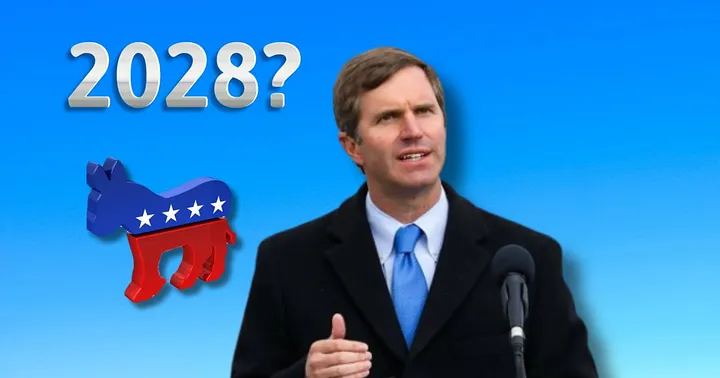
Two southern states have Democratic governors juxtaposed by Republican-led chambers: North Carolina has Gov. Josh Stein, and Kentucky has Gov. Andy Beshear. Stein, who was elected last November, is a rookie compared to Beshear. Beshear will complete his final term in 2026.
During Beshear’s tenure as governor, which began in December 2019, the Republican Party has consistently held the majority in both chambers of the Kentucky General Assembly: the state House of Representatives and the state Senate.
The Republican Party has controlled the Kentucky State Senate since 1999. As of the 2025 session, Republicans hold 31 of the 38 seats, maintaining a supermajority.
This Republican dominance in the legislature has enabled the party to set the legislative agenda and override Governor Beshear’s vetoes. For instance, in the 2024 legislative session, Republicans upheld their supermajorities, allowing them to pass legislation against the governor’s objections.
Despite leading a deeply Republican state, Democratic Governor Andy Beshear has achieved several notable bipartisan accomplishments by collaborating with Kentucky’s GOP-controlled legislature. Here are some key examples:
1. Legalization of Medical Marijuana
In 2023, Governor Beshear legalized medical cannabis, with Beshear and Republican lawmakers jointly celebrating the achievement.
2. Sports Betting
Kentucky legalized sports wagering, marking a major policy shift supported by both parties. Beshear praised these efforts as examples of “divided government working to get the tough things done that voters want”.
3. Expansion of Voting Access
In a rare move among Republican-led states, Kentucky expanded voting access through House Bill 574. The law introduced three days of early in-person voting, transitioned the state toward universal paper ballots, and maintained an online portal for requesting absentee ballots. Governor Beshear signed the bill into law, highlighting its bipartisan support and its role in making voting more accessible for Kentuckians
4. American Rescue Plan Investments
Beshear and legislative leaders from both parties collaborated to allocate federal American Rescue Plan funds toward critical infrastructure projects. The bipartisan agreement directed investments into building better schools, expanding broadband, providing clean drinking water, and creating more than 14,500 jobs across the state.
5. Income Tax Reduction
In 2025, the Kentucky House passed House Bill 1, which reduced the state’s income tax. The bill received bipartisan support, with Governor Beshear signing it into law. Republican leaders credited the tax cut for bolstering Kentucky’s economy and noted the collaborative effort in achieving this legislative milestone.
Beshear has prioritized attracting businesses to Kentucky. He promoted the state at the World Economic Forum in Davos, Switzerland, highlighting Kentucky’s workforce and potential for corporate expansion, especially in the electric vehicle battery sector.
Regardless of how Trump’s final year ends in 2028, independent voters will have at least one new choice at the top of the ticket, and most likely, the Democratic candidate will also be new, unless Kamala Harris opts to run and defies the odds against her. It’s safe to assume that voters who aren’t blindly loyal to either Republicans or Democrats will want a candidate with a proven track record of working with the opposing party to reach compromises and deliver positive results.
Kentucky Congressman Thomas Massie, a Republican known for his steadfast commitment to fiscal conservatism, opposed the Republican-led “Big Beautiful Bill”, and spoke to comedian Theo Von about the testy relationship he has experienced with Trump during both of Trump’s terms in office.
RALEIGH, N.C. — U.S. Senator Thom Tillis, a Republican who has represented North Carolina since 2015, announced that he will not seek re-election in 2026, marking the end of a decade-long tenure characterized by conflicts with members of his own party, including President Donald Trump.
Sen. Tillis made the announcement just hours after he voted against advancing Trump’s proposed tax bill, which drew sharp criticism from President Trump. In a statement, Tillis expressed his disillusionment with the political climate in Washington, stating he wishes to prioritize family life over serving another term in the Senate.
“As many of my colleagues have noticed over the last year, and at times even joked about, I haven’t exactly been excited about running for another term,” Tillis said. “That is true since the choice is between spending another six years navigating the political theater and partisan gridlock in Washington or spending that time with the love of my life, Susan, our two children, three beautiful grandchildren, and the rest of our extended family back home. It’s not a hard choice, and I will not be seeking re-election.”
Tillis’s departure is expected to spark a heated and costly battle for the seat in this politically competitive state, where Trump remains highly influential among Republican primary voters. Trump has previously suggested the possibility of supporting a challenger to Tillis, highlighting the growing rift between the two men.
Their strained relationship has been evident over the years. During a Senate hearing on Trump’s tariff policies, Tillis once directly asked administration officials, “If these tariffs don’t work, whose throat do I get to choke?” This remark underscored his skepticism of Trump’s trade war strategy and his willingness to confront the administration on key issues. The comment became a symbol of Tillis’s often uneasy alignment with the former president, reflecting both his policy concerns and the political balancing act he faced in a deeply divided party.