Home Blog Page 21

Tennessee Senator Presses Biden Official on Plans to Defund Immigration Enforcement

Below is a press release from U.S. Sen. Bill Hagerty, (R-Tenn).

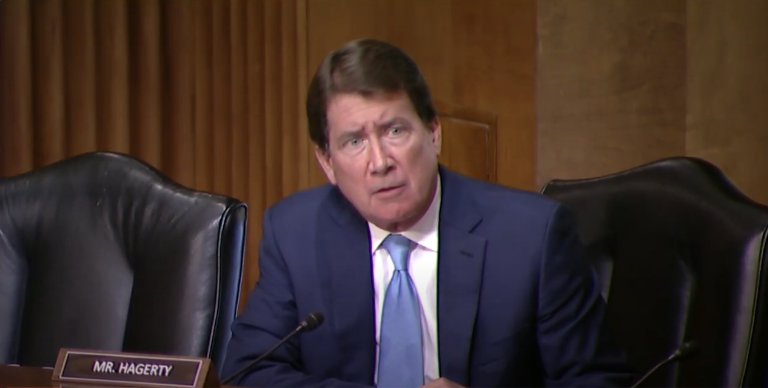
WASHINGTON—United States Senator Bill Hagerty (R-TN), a member of the Senate Foreign Relations Committee, today pressed Assistant Secretary of State Brian Nichols on a hidden provision in President Joe Biden’s supplemental funding request that would enable the White House to effectively abolish U.S. Immigration and Customs Enforcement (ICE)—the federal law enforcement agency tasked with protecting Americans from crime, drugs, and illegal immigration—by defunding the agency and reallocating its funds to transport and resettle illegal immigrants across the United States.

Hagerty called out the Biden Administration’s hypocrisy for including more than one billion dollars for international law enforcement funding in its FY 2024 budget request, including for foreign police to address violence and drug trafficking in Latin American countries like Colombia, while requesting that Congress defund ICE, an American law enforcement agency, here in the United States.


“There’s over a billion dollars in the budget request for law enforcement in other countries, law enforcement in Latin America, places like Colombia where policing needs to be reinforced, dealing with counter-narcotics, trafficking and that sort of thing,” said Hagerty. “I presume then you would oppose defunding this component of the FY 2024 budget request?”

Assistant Secretary Nichols replied, “Absolutely, Senator.”

Hagerty then asked Nichols about the White House’s supplemental funding request to Congress, which President Biden proposed to include in legislation to fund the government past September 30. Page 51 of that request includes a provision granting the Department of Homeland Security (DHS) authority to reprogram ICE funding for services and support to migrants, including “through contracts[,] . . . grants or cooperative agreements to non-governmental organizations”—effectively changing ICE’s mission from one focused on law enforcement and combating illegal immigration to one focused on illegal alien resettlement in American communities.

“It’s very shocking to me that in order to avoid a government shutdown, the President is demanding the ability to defund ICE here in America,” Hagerty said.

Gov. Roy Cooper Hosts Education Roundtable in Eastern North Carolina

0

Below is a press release from North Carolina Gov. Roy Cooper.

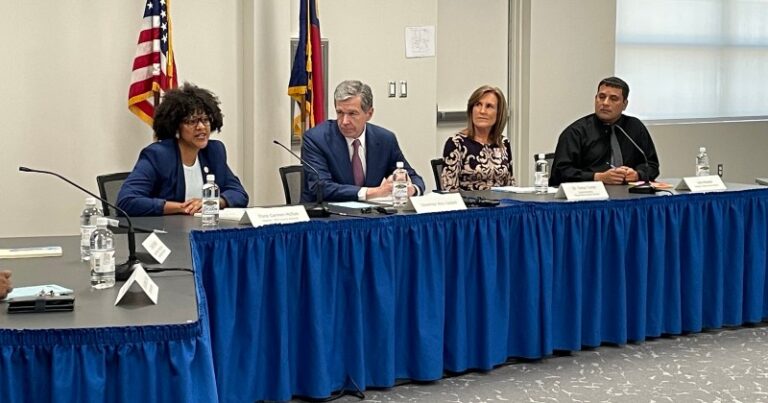
Governor Roy Cooper hosted a roundtable discussion at the Kathy Taft Center for Leadership and Excellence in Pitt County to highlight the extreme Republican plans to undermine and underfund public education in North Carolina. The Governor was joined by superintendents, school board members, teachers and local elected officials to discuss the disastrous impact Republican legislation would have on North Carolina’s public schools and the urgent need for legislators to do their jobs by passing a budget that makes meaningful investments in public education.

“Education leaders across the state continue to speak out against unaccountable private school vouchers for the wealthy that will hurt our public schools,” said Governor Cooper. “It’s time for a budget that makes meaningful investments in public school teachers and students.”

“The private voucher system does not provide a uniform system of education for all students as the options are limited to many children due to the need for transportation, the need for special services, and other needed resources including the ability to receive free or reduced meals,” said Perquimans County Schools Superintendent Dr. Tanya Turner. “By increasing the private vouchers, funding provided by our taxpayers for a uniform system of education will be significantly decreased which will greatly impact the quality of education provided by our public schools. Our country has worked hard for equity among all groups of people and public education is the foundation for this to be achieved.”

“I am very appreciative of the opportunities brought forth by Governor Cooper to bring these educational issues to the forefront. It is imperative that parents, students, community members and educational stakeholders continue to stay on top of our needs and issues to help us by supporting our efforts, contacting legislators and ultimately making sure we elect officials whose voting records truly reflect support and growth for their communities and districts,” said Julio Morales, English as a Second Language Teacher in Hyde County. “The success of public schools is everyone’s business if we care to have a promising future for our state.”

In May 2023, the Hertford County, Hyde County, Perquimans County and Pitt County superintendents signed onto a letter with other superintendents in the northeast region highlighting the negative impacts that the proposed voucher expansion would have on school districts in their region. As Republican leaders go yet another week without passing a new budget, education leaders in 40 school districts across North Carolina have spoken out against these extreme plans that gut funding for public education.

Republicans have pushed a series of sweeping legislation that would dismantle public education. These dangerous bills would cause public schools to lose hundreds of millions of dollars, worsen the state’s teacher shortage and bring political culture wars into classrooms. The proposed voucher program expansion would pour billions of dollars in taxpayer money into private schools that are unaccountable to the public and can decide which students they want to admit. Their plan would expand private school vouchers so anyone – even a millionaire – can get taxpayer money for their children’s private school tuition.

Expanding voucher eligibility to any K-12 student will force public schools, especially those in rural and poorer counties, to make steep cuts, leaving schools without the resources to hire enough teachers and support students.

In a special address, Governor Cooper declared a State of Emergency for Education and called on North Carolinians to visit governor.nc.gov to learn more and contact their legislators to ask them to protect public schools.

Georgia Senator Jon Ossoff Working to Pass ‘Partner with Korea Act’

Below is a press release from Georgia U.S. Senator Jon Ossoff.

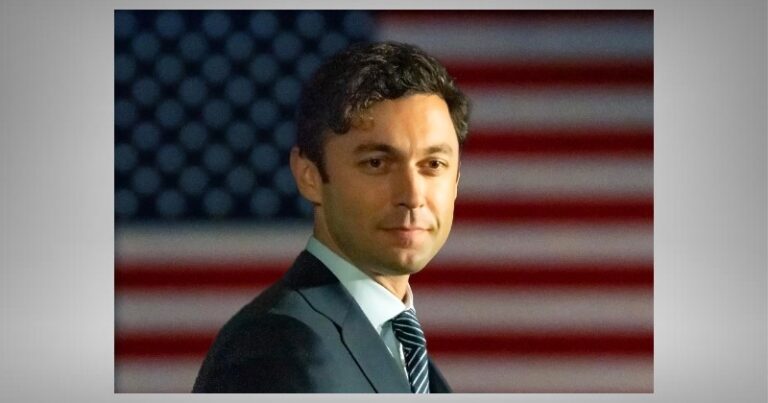
Washington D.C. – U.S. Senator Jon Ossoff, co-founder of the U.S. Senate Korea Caucus, is continuing his work to strengthen the friendship between the U.S. and the Republic of Korea.

Sen. Ossoff is working across the aisle to pass the bipartisan Partner with Korea Act to encourage greater ties between American and Korean businesses. 

The bill would build on this strong and growing bilateral relationship by encouraging greater ties between American and Korean businesses.

“As the Senate’s number one champion of the US Korea alliance, and a steadfast friend of Georgia’s Korean American community, I’m continuing my bipartisan work to strengthen relations between the U.S. and the Republic of Korea,” Sen. Ossoff said.

Sen. Ossoff remains a leader in the U.S. Senate pursuing stronger relations with South Korea, maintaining frequent contact with senior South Korean diplomatic and economic officials.

Sen. Ossoff led his second economic delegation to Seoul earlier this year to continue pushing for additional Korean investment in Georgia and establishing Georgia as the advanced manufacturing hub in the U.S.

Sen. Ossoff met with South Korean President Yoon Suk-Yeol as well as top South Korean government officials and business executives.

Sen. Ossoff’s first successful economic delegation to South Korea in November 2021 yielded economic results for Georgia families. In 2022 alone, following his trip, Hyundai, Hanwha Qcells, and SK invested over $8 billion in Georgia, creating over 10,000 jobs.

Click here to read the Partner with Korea Act.

Florida Rep. Matt Gaetz Accuses ATF of Retaliation Against Congressional Witness

Below is a press release from Florida Congressman Matt Gaetz (R).

Washington, D.C.  Yesterday, September 6th, 2023, U.S. Congressman Matt Gaetz (FL-01) was informed of retaliation and harassment by agents of the Bureau of Alcohol, Tobacco, Firearms and Explosives (ATF) against congressional witness Chris Smith, owner of Gulf Coast Gun in Milton, Florida. Today, Rep. Gaetz sent a letter to ATF Director Steven Dettelbach demanding answers regarding the agency’s targeted harassment against a congressional witness.

Chris Smith, owner of Gulf Coast Gun, testified on June 26th, 2023, at a congressional field hearing hosted by Rep. Gaetz on the weaponization of the ATF and its heightened targeting of Federal Firearms Licensees (FFL). This week, in an alleged violation of federal law, ATF agents showed up at his business to aggressively audit and harass him over a license he has only held for six months and has yet to use. Mr. Smith has not yet used the license, so the agents had nothing to inspect and had no choice but to leave. The local ATF agent admitted he had no records that Mr. Smith was using the license but nevertheless received a direct order to audit his new license in violation of the Firearm Owners Protection Act of 1986.

Additionally, ATF agents showed up unannounced later that evening at his store manager’s home, despite the manager not being involved in the sale of firearms or the business of Gulf Coast Gun. The manager was not home, so ATF agents gave him a menacing call and said:“Don’t worry, we know where you work.”

Full text of Congressman Gaetz’s letter to ATF Director Steven Dettelbach can be found HERE. Additionally, exclusive coverage of the letter by Breitbart News can be found HERE.

LETTER TEXT

Dear Director Dettelbach:

It has come to my attention that yesterday, September 6, 2023, ATF agents once again aggressively targeted and harassed one of my constituent federal firearms licensees (FFL), Chris Smith of Gulf Coast Gun, this time apparently in violation of federal law. Chris has held an FFL in Florida for years with no issues, and yet the ATF has aggressively audited him without merit and accused him of various clerical errors in an attempt to have his FFL revoked. It is for this reason that Chris testified as a whistleblower before members of Congress.

After Chris’ testimony at my Field Hearing on the Weaponization of the Bureau of Alcohol, Tobacco, Firearms and Explosives, ATF agents showed up at his business unprompted to inspect a manufacturer’s license he has held for only six months: Given Chris has not yet used the license, the agents had nothing to inspect and had no choice but to leave. The ATF had previously audited Chris’ retail license within the last year, and it follows that given the ATF is forbidden from auditing the same business twice in one year, the only excuse the ATF had to harass Chris further was to audit a new, unused manufacturer’s license.

The local ATF agent admitted that he had no records Chris was using the license, but nevertheless received a direct order to audit Chris’ new license. However, under the Firearm Owners Protection Act of 1986, the ATF’s delegated authority from the Department of Justice to “inspect the inventory and records of a licensed collector without such reasonable cause or warrant” can only be for the purpose of “ensuring compliance with the record keeping requirements of this chapter not more than once during any twelve- month period” (emphasis added) (18 U.S.C. 923(g)(1)(C). A single, vertically integrated manufacturer and seller of firearms is required, under the law, to maintain records and does not become two individuals subject to two unjustified annual inspections merely because your agency has decided to ask for additional paperwork.

In addition to this violation of federal law, the ATF showed up uninvited to the home of Christian O’Brien, Chris’ store manager, without making an appointment, as he does not have business hours. Christian does not sell any firearms or perform any business on behalf of Gulf Coast Gun. Christian was not home at the time, so the agents called him and told him: “Don’t worry, we know where you work.” This kind of stalking is unwarranted and creepy.

The ATF’s harassment of law-abiding FFLs is clear and documented. Furthermore, the implication that the ATF may be retaliating against congressional whistleblowers in response to their lawful actions before Congress is astounding. In order for the House Committee on the Judiciary, of which I am a member, to conduct oversight of this matter, at your immediate availability, please provide answers to the following questions:

(1) How many audits and/or inspections have the ATF performed on a license held only for six months? (2) For what reason did the ATF decide to attempt an inspection on Chris’ new license?

(3) For what reason was the ATF seeking to speak with Christian O’Brien?

(4) For what emergency did the ATF find it necessary to perform a house call to someone who is not involved in the sale of firearms on behalf of Gulf Coast Gun?

(5) Who at the ATF made the decision to audit the unused license of a congressional whistleblower after giving his testimony?

(6) What rules, regulations, or other agency documents does the ATF rely upon for its apparent position that multiple licenses for a single licensee subjects the licensee to multiple warrantless inspections within a 12-month period? Please provide those documents.

Sincerely,

Matt Gaetz

Member of Congress
Florida Sen. Rick Scott Asks Sen. Schumer to Separate Ukraine Funds from U.S. Disaster Funding

Following Hurricane Idalia’s path across the southeastern region of the country, Florida Sen. Rick Scott is asking U.S. Sen. Majority Leader Chuck Schumer (D – NY) to take Ukraine funding out of legislation for Federal Disaster Relief funding.

Sen. Scott took simlar stances in the past when other disaster relief bills included earmarks for unrelated projects that some considered pork barrel spending. In a statement released yesterday, Sen. Scott expressed the importance of keeping foreign aid seperate from domestic spending, amd offered his Federal Disaster Responsibility Act as an alternative solution.

Below is a copy of Sen. Scott’s letter to Sen. Schumer.

The Honorable Chuck Schumer

Majority Leader

United States Senate

Washington, D.C. 20150

Dear Leader Schumer:

On Wednesday, August 30, Hurricane Idalia made its catastrophic landfall in Florida’s Big Bend near Keaton Beach as a major, Category 3 hurricane. Just days after this storm cut through my state, I met with President Joe Biden in Live Oak, Florida, to talk with him one-on-one about the need to pass my Federal Disaster Responsibility Act. I thanked the president for his quick action to approve Florida’s request for both a pre-landfall disaster declaration that helped local law enforcement respond and a subsequent major disaster declaration, but also made clear that there is much more work to be done.

Unfortunately, it is my understanding that at least one member of the Senate Democratic Caucus plans to block the immediate passage of this legislation to provide Americans with urgently needed relief unless it is accompanied by foreign aid for Ukraine. Such action by a member of the Senate, especially one whose state has an active major disaster declaration, is senseless and incredibly harmful to our fellow Americans fighting to recover from devastating disasters. We cannot allow this to happen.

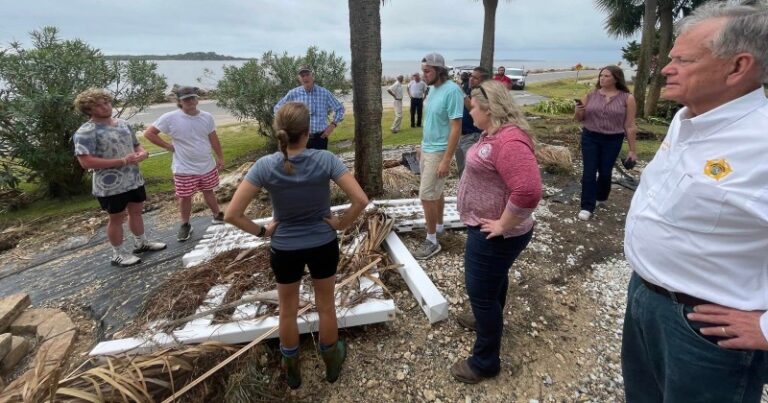
Last week, I saw firsthand the damage caused across Florida’s Big Bend by Hurricane Idalia’s devastating wind speeds, historic storm surge, and heavy rainfall which severely impacted substantial portions of the state with significant flooding and massive power outages. Floridians are resilient, but recovery doesn’t fall just on these families—it’s an all-hands-on-deck operation that requires the federal government to show up today, tomorrow and every day until the job is done. The Federal Disaster Responsibility Act will deliver on that commitment for families in Florida, California, Hawaii, and in communities across the United States fighting to recover from major federal disasters by passing several important provisions, which include:

  • Fully funding the immediate needs of FEMA’s Disaster Relief Fund with at least $16.5 billion to ensure the federal government can uphold its obligation to quickly deploy emergency funding and resources to communities and Americans impacted by natural disasters. This exceeds what the Biden administration has said is needed to respond to recent disasters, including those in Florida and Hawaii.
  • Ensuring final passage of the bipartisan Block Grant Assistance Act which provides needed authority for the U.S. Department of Agriculture to issue block grants to Florida’s citrus growers, Georgia’s peach growers and all U.S. agriculture producers devastated by natural disasters in 2022.
  • Securing final passage of an expanded version of the Hurricane Tax Relief Act, which takes care of Americans impacted by disasters by providing disaster-loss tax relief to families who have been impacted by qualified disasters for purposes of enhanced disaster casualty loss tax relief. This would apply across the nation and include relief for taxpayers in Hawaii, California, Illinois, Florida and others. This bill modifies the deduction for personal casualty losses in the hurricane disaster areas, waiving the requirements for impacted taxpayers to itemize deductions and to have losses that exceed 10% of adjusted gross income. Congress previously extended this tax relief for hurricanes Irma, Wilma, Dorian, and Michael, amongst others.
  • Committing necessary funds and resources to Florida’s military installations to fully rebuild and recover from hurricane damage.

We are all aware that disasters do not discriminate in the damage they cause. Any one of our states could face an emergency at any time and the federal government must be prepared to show up and deliver relief to Americans impacted by these events.

The Senate must make clear to the American people that Washington won’t play games with disaster relief funds or make helping Americans contingent on helping foreign causes, which require more debate and scrutiny. We can and must pass this bill this week and I urge your full support and immediate action to get this done.

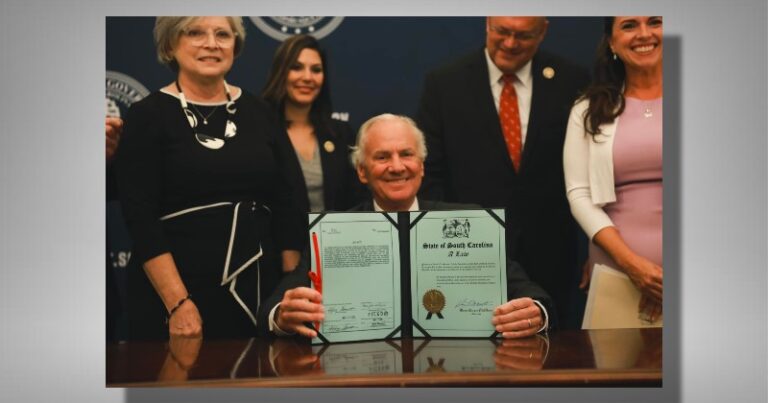
South Carolina Governor Henry McMaster Holds Ceremonial Bill Signing for State’s Alzheimer’s Plan

Below is a press release from South Carolina Gov. Henry McMaster.

COLUMBIA, S.C. – Governor Henry McMaster was joined today by the South Carolina Alzheimer’s Association, state agency leaders, and members of the General Assembly for a ceremonial bill signing of S. 569, which requires the advisory council for the Department on Aging’s Alzheimer’s Resource Coordination Center to maintain and update a comprehensive statewide plan to address Alzheimer’s disease and related dementias.

“As many of us know all too well, Alzheimer’s is a cruel and fatal disease, impacting over a hundred thousand South Carolina families each year,” said Governor Henry McMaster. “With this signing, we create a unified, long-term approach to combating Alzheimer’s, allowing our state to maximize its resources, and signal to all families battling this disease that South Carolina is committed to improving care and treatment until we find a cure.”

The advisory council must gather input from the Department of Health and Environmental Control (DHEC), the Department of Health and Human Services (DHHS), and the Department of Social Services (DSS) to ensure the plan meets the needs of the state.

“South Carolina has many, many challenges as we face a dementia crisis that plagues our state. From a lack of geriatricians and neurologists to scarce resources for patients and families, we have unfortunately fallen behind for far too long,” said South Carolina Senator Katrina Shealy. “Through this newly codified state plan, we will be able to identify the resources we need, where we need them, and the best way to obtain them so that South Carolina no longer lags behind our neighbors but can become a leader in this field.”

South Carolina’s latest Statewide Plan to Address Alzheimer’s Disease and Related Dementias was released in February of 2023. Before this year the plan was last updated in 2009. 

The council must submit an annual report to the Governor and the General Assembly by September 30, concerning the plan’s progress and must update the plan in 2028 and every five years thereafter. 

“Today, South Carolina takes the first step to make sustainable change for families facing dementia,” said Taylor Wilson, Chair of the Alzheimer’s Resource Coordination Center Advisory Council. “This bill ensures that progress will be shared annually with the legislature and also ensures that we do not give up at the end of five years, it certifies we will come back to the table to plan and implement lifelines to caregivers across this state with strategic purpose and vision.”  

The bill passed the House 110-0 and passed the Senate 43-0.

Sen. Bill Cassidy Announces $1 Million for Parks in Louisiana

Below is a press release from U.S. Sen. Bill Cassidy (R – Lou).

WASHINGTON – U.S. Senator Bill Cassidy, M.D. (R-LA) announced the National Park Service will grant Louisiana $1,021,111.00 from the Land and Water Conservation Fund (LWCF). The City of West Monroe will receive $770,161.00 to rehabilitate and expand existing amenities at Kiroli Park. The City of Thibodaux will receive $250,950.00 to rehabilitate and develop a ballfield at Peltier Park to meet Miracle League guidelines.

“Parks serve as a great place for families to come together and enjoy the great outdoors,” said Dr. Cassidy. “This funding from energy production in the Gulf of Mexico will provide increase recreational opportunities for our communities.”  

LWCF derives its revenue from offshore oil and gas development and provides those funds as grants to federal, state and local governments for recreation and conservation projects.

Sen. Katie Britt Praises $44.5 Million Investment in the University of Alabama

Below is a press release from Republican Sen. Katie Britt of Alabama.

Washington, D.C., September 5, 2023 – U.S. Senator Katie Britt (R-Ala.) today praised the disbursement of $44.5 million from the U.S. Department of Commerce’s National Institute of Standards and Technology to the University of Alabama for the establishment of a High-Performance Computing and Data Center for Water and Hydrological Scientific Research, Education, and Forecasting on UA’s campus in Tuscaloosa.

The new facility, which will be part of the Office of Research and Economic Development, will house state-of-the-art supercomputers and research equipment for modeling and simulation. Supercomputing is a key driver of world-class, modern-day research.

The University of Alabama is the international epicenter of water research, housing the Alabama Water Institute, National Water Center, and Global Water Security Center. This project will continue to grow the University’s hydrological leadership, expertise, and multi-pronged collaboration with the federal government, including the Department of Defense, National Oceanic and Atmospheric Administration, and U.S. Geological Survey.

“The hydrological research conducted at the University of Alabama is critical to our country’s national security and future,” stated Senator Britt. “This targeted, strategic federal investment will enable researchers across the University of Alabama System to continue to make groundbreaking discoveries and contributions to our state and nation.”

“This funding will greatly enhance UA’s ability to make scientific and engineering advances that support critical work in water security, as well as research in a variety of areas of water related science,” said UA President Stuart Bell. “Not only will it strengthen collaboration across the UA system and between our students and key players in the growing water industry and other scientific research areas, but it will also develop the technical skills that our students can then apply in valuable careers that will support new industry opportunities in our state.”

The funding for this project was initially secured by former Senator Richard Shelby (R-Ala.).

The University of Alabama, which holds the highest research designation from the Carnegie Classification of Institutions of Higher Education, has a total statewide economic impact of $2.8 billion annually and supports more than 13,000 jobs.