
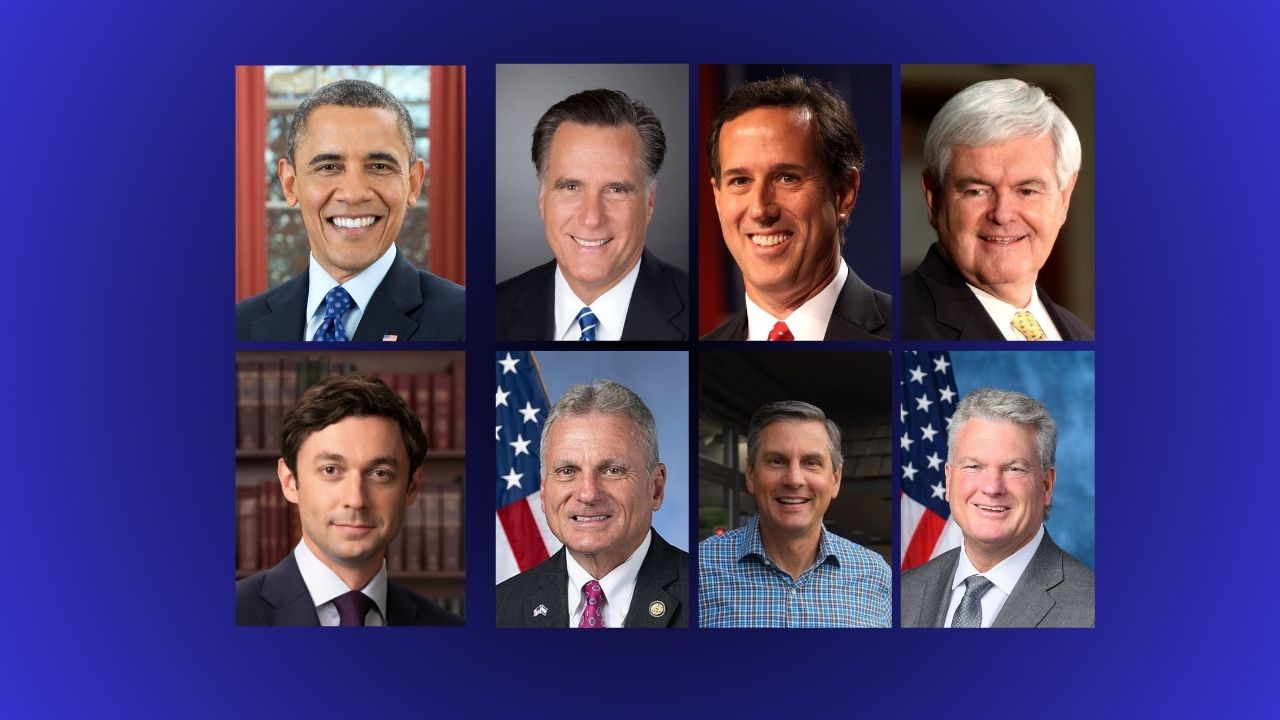
here’s a familiar political pattern quietly taking shape in Georgia—and if Republicans aren’t careful, they’ve seen this movie before.
Back in 2012, incumbent President Barack Obama didn’t just win reelection because of his own strengths. He benefited from something just as powerful: a Republican Party that spent months beating itself up in a bruising primary.
The GOP field that year—Mitt Romney, Newt Gingrich, and Rick Santorum—turned the nomination fight into a prolonged ideological civil war. What should have been a launchpad into the general election became a demolition derby.
Now fast forward to 2026, and Georgia Senator Jon Ossoff is staring at a political landscape that looks eerily similar.
The Obama 2012 Blueprint: Let the Opponent Self-Destruct
In 2012, Republicans had energy. They had momentum. They had a base hungry to defeat Obama.
What they didn’t have was unity.
Romney was cast as the establishment pick. Gingrich positioned himself as the intellectual insurgent. Santorum surged with social conservatives. Each took turns attacking the others—not just on policy, but on electability, authenticity, and character.
By the time Romney emerged as the nominee:
- He had spent months defending himself from his own party
- His campaign had burned through resources
- Key factions of the GOP base were lukewarm at best
Meanwhile, Obama sat back, conserved resources, and let the chaos play out. By the time the general election began in earnest, he wasn’t facing a fresh challenger—he was facing a worn-down survivor.
Georgia 2026: A Replay in Progress?
That same dynamic is now forming in Georgia.
Republicans are heading toward what is shaping up to be a crowded, high-stakes, and deeply competitive primary. Multiple candidates are vying not just to win—but to define what the Republican Party in Georgia even is.
And that’s where Ossoff’s opportunity emerges.
Because every dollar Republicans spend attacking each other is a dollar not spent defining him. Every headline about intra-party conflict is a headline that keeps Ossoff out of the crosshairs.
If the GOP primary drags on:
- The eventual nominee will be financially depleted
- The base could emerge divided
- Messaging will be delayed and diluted
Sound familiar?
The Hidden Advantage: Time and Contrast
Ossoff doesn’t need to dominate the news cycle right now. In fact, the smartest strategy may be the quietest one.
Just like Obama in 2012, he can:
- Build a massive fundraising advantage while Republicans spend internally
- Define his opponent early once a nominee emerges
- Position himself as the stable, unified option against a fractured opposition
There’s also a deeper psychological factor at play.
Primary fights tend to push candidates toward the ideological edges. That may win primaries—but it can complicate general election messaging in a state like Georgia, where margins are razor-thin and persuasion voters still matter.
Obama benefited from this contrast in 2012. And Ossoff could too.
The Risk Republicans Can’t Ignore
This isn’t to say Republicans can’t win Georgia in 2026. They absolutely can.
But if history is any guide, how they choose their nominee may matter just as much as who they choose.
A short, disciplined primary? That’s survivable.
A prolonged, expensive, and personal battle? That’s a gift.
Because elections aren’t just about ideology or turnout. They’re about timing, resources, and momentum.
And right now, the early signs suggest Republicans may once again be in danger of handing all three to the incumbent.
The lesson from 2012 is simple: incumbents don’t always have to win the election outright—sometimes their opponents lose it first.
If Georgia Republicans repeat the mistakes of Romney, Gingrich, and Santorum, Jon Ossoff won’t just be defending his seat.
He’ll be watching history repeat itself—one primary attack ad at a time.