
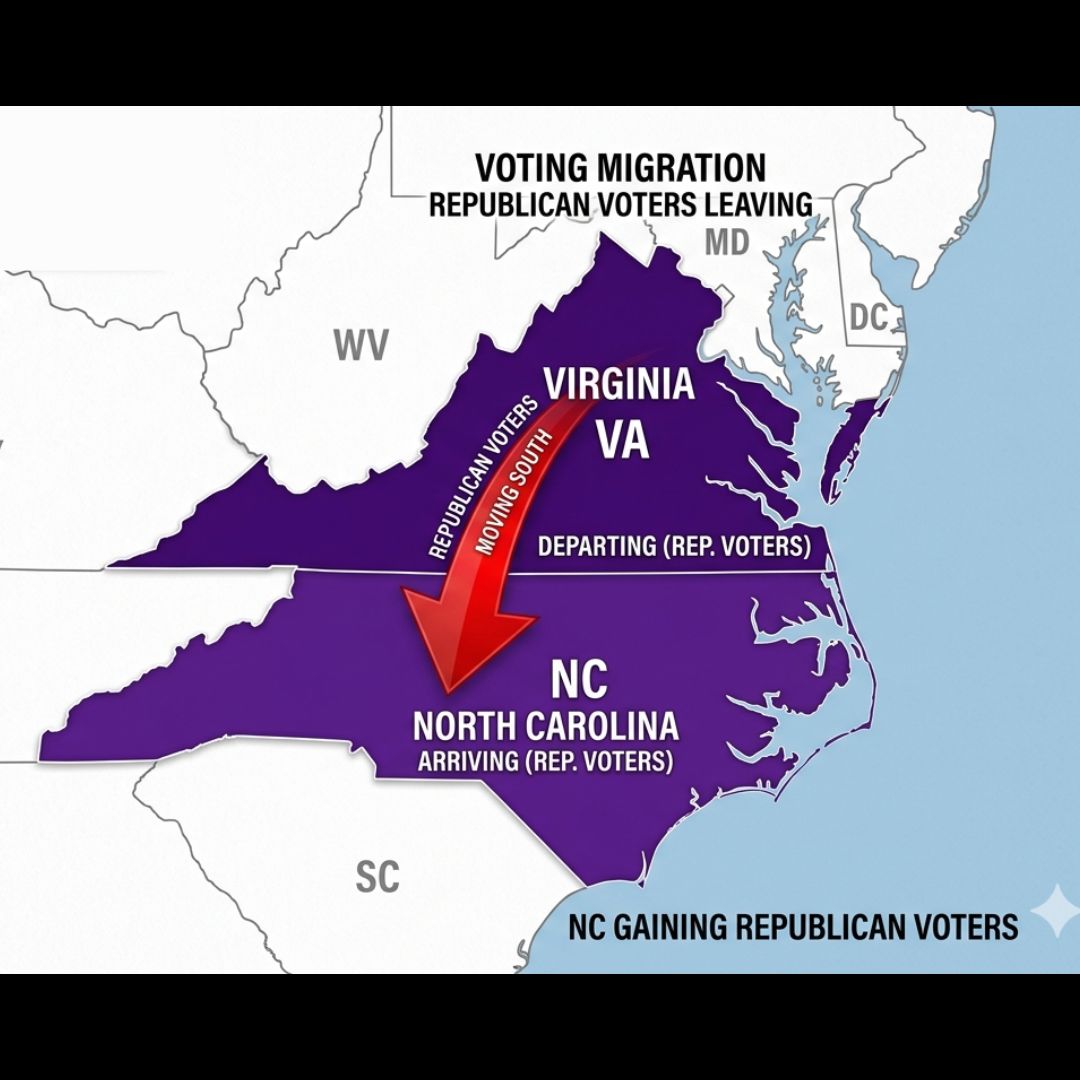
As Virginia’s new governor, Democrat Abigail Spanberger, moves away from Gov. Glenn Youngkin’s fiscally conservative policies and implements higher taxes, more regulations, and policies that have historically increased the cost of living, some moderate and conservative Virginians may begin looking south—specifically to North Carolina.
If that migration occurs at scale, it could reduce Republican influence in Virginia while also complicating Democrats’ long-term efforts to expand their footprint in the swing state of North Carolina.
For years, population migration has quietly reshaped American politics. States such as Texas and Florida have experienced a rapid influx of residents from higher-tax states, while others have seen population losses tied to taxes, housing costs, and expanding regulations.
Now, a similar dynamic could be developing between Virginia and North Carolina.
Virginia’s Changing Political Landscape
Virginia has undergone a dramatic political transformation over the past two decades.
Once considered a competitive purple state, Northern Virginia’s population growth and the expansion of federal employment have helped shift the state toward Democrats in statewide elections.
At the same time, concerns about rising housing costs, energy prices, and taxes have become more common in parts of the state outside the Washington D.C. suburbs
Among the state delegation, Democrats hold the majority in both chambers of Virginia’s state legislature, which gives Gov. Spanberger the ability to implement more policies that increase fees, taxes and regulations. Her agenda will be backed by Virginia Speaker of the House Don Scott (Democrat and Virginia Senate Majority Leader: Scott Surovell (Democrat). Virginia’s House of Delegates has 64 Democrats to 36 Republicans.
As a neighboring state, North Carolina is an obvious destination for residents looking for lower costs while remaining relatively close to home.
North Carolina’s “Split Government”
North Carolina currently operates under a unique political balance.
The state elected Democratic Governor Josh Stein in 2024, succeeding Roy Cooper. However, Stein’s authority is balanced by a Republican-controlled legislature, creating a system where policy often lands somewhere near the middle.
That structure has produced economic policies that many business groups consider competitive compared to other East Coast states.
North Carolina has:
• Lower overall tax burdens than many northeastern states
• Corporate tax reductions implemented in recent years
• Rapid job growth in banking, technology, and manufacturing
• Major population inflows into the Raleigh-Durham and Charlotte regions
The result has been one of the fastest-growing economies in the Southeast.
Why Migration Could Shift North Carolina Politics
When people move, they don’t just bring their furniture.
They bring their voting habits.
If a meaningful number of moderate or conservative Virginians relocate to North Carolina because of economic policy differences, two political shifts could occur simultaneously.
North Carolina could gradually trend more conservative, particularly in suburban counties that are already politically competitive.
Meanwhile, Virginia could become more solidly liberal as voters most frustrated by taxes, regulation, or rising costs relocate elsewhere.
A Pattern Seen in Other States
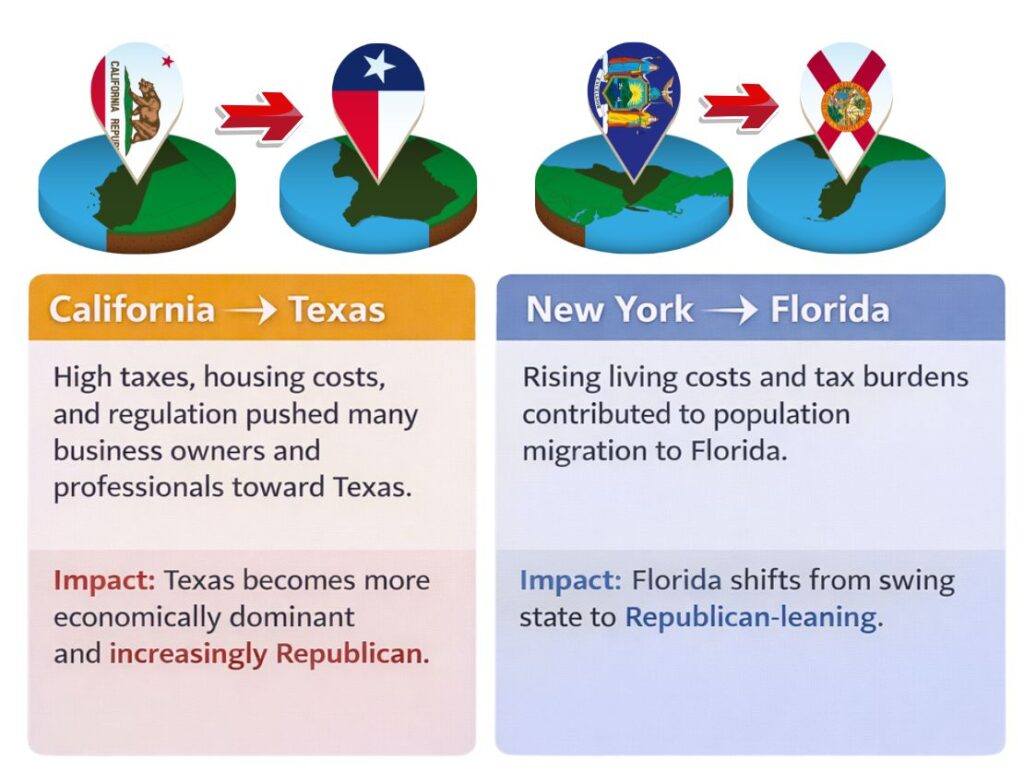
This type of migration has already occurred in other parts of the country.
Over the past decade, states like New York and California have seen significant population outflows tied in part to housing costs, taxes, and regulatory environments.
Many of those residents have relocated to states such as Florida, Texas, Tennessee, and North Carolina—places that market themselves as more affordable and business-friendly.
Florida, for example, has become more reliably Republican over the past decade while attracting large numbers of residents from the Northeast.
Texas has also seen major inflows from California, particularly among entrepreneurs and professionals seeking lower costs and fewer regulatory hurdles.
If Virginia begins experiencing a similar outflow, the Southeast could see its own version of that migration pattern—one driven not by cross-country moves but by regional relocation.
If this theory holds true, the migration patterns would likely follow several specific corridors:
• Northern Virginia residents relocating to the Research Triangle region
• Southwest Virginia residents moving into North Carolina’s Piedmont Triad
• Retirees moving toward coastal North Carolina communities
These moves allow migrants to remain relatively close to family networks while gaining access to lower costs and growing job markets.
Migration has the potential to reshape a state’s political balance over time.
If Virginia’s policies push costs higher while North Carolina maintains a competitive economic environment, the Virginia-to-North-Carolina migration pipeline could become one of the most important political trends in the Southeast over the next decade.
In that scenario:
• Virginia becomes more reliably Democratic
• North Carolina becomes more reliably Republican
• The political center of gravity in the Southeast gradually shifts southward